· Chris Landtiser · Human Skills & Development · 8 min read
The Secret Life of Prompt Personas
Discover how using personas in your AI prompts can dramatically improve context and the quality of your results. Learn why this simple shift in communication changes the conversation and unlocks deeper, more creative collaboration with tools like Copilot.
I recently brainstormed with a colleague after they had spent half an hour wrestling with Copilot, trying to get it to write a collection of User Stories for a Feature in Azure DevOps. The AI kept producing what I can only describe as Wikipedia meets corporate buzzword bingo. Frustrated, she finally typed: “As a marketing director who actually cares about engaging employees, write these stories.”
The transformation was instant. And it reminded me why I’ve put so much effort in advocating for this approach lately - it’s a simple, non-technical multiplier that leans into the natural strengths of generative AI!
The Invisible Frame We’re All Using
Every interaction with Copilot happens through a lens, even when we think we’re being neutral. When you type a straightforward question like “Explain our new project timeline,” you’re still giving Copilot a frame of reference. It’s just that you’re accepting its default persona: that helpful, somewhat academic assistant who sounds like they’re perpetually sitting in a well-lit library, ready to explain things clearly but never too personally.
That default voice? It’s a persona too. We’ve just gotten so used to it that we forget it’s there, like how you stop noticing the hum of the office HVAC after a while.
When we explicitly change that frame, when we say “As a sales rep explaining to a skeptical customer” versus “As a product manager writing internal documentation”, we’re not just changing the answer. We’re fundamentally reshaping how AI approaches the problem.
Why Our Brains (and Copilot) Love a Good Character
Stories have always been how humans make sense of complexity. Maybe you wouldn’t remember a particular history fact, but for the teacher who made it unforgettably funny. I certainly can’t recall all our company policies on command, but I have years of analogies and mental frameworks shared with me by many leaders from around Huron.
AI works similarly, though for different reasons. When you give Copilot a persona, you’re not just adding flavor text! You’re activating entire networks of associations that the model has learned. Assigning personas can significantly impact the tone, vocabulary, and overall content of Copilot’s responses. Say “marketing director” and you’re invoking patterns around persuasion, audience awareness, and brand voice. Say “research scientist” and you’re calling up precision, methodology, and careful qualification of claims.
Imagine you’re at a dinner party, and someone asks about your work. Your explanation to your tech-savvy friend differs from what you’d tell your grandmother, which differs from what you’d share with a potential investor. You’re still you, but you’re adapting your communication style, vocabulary, and focus based on who you’re trying to connect with. That’s exactly what persona prompting does for Copilot. It helps understand not just what to say, but how to say it and why it matters.
The Reality Check
Now, before everyone on the team rushes off to prompt Copilot as “the world’s greatest expert in whatever we need,” let me share what I’ve discovered actually works and what’s just dressed-up wishful thinking.
Recent research has painted a nuanced picture that aligns with what I’ve been seeing in practice. Persona prompting is effective on open-ended tasks like creative writing, but probably won’t help much on accuracy-based tasks. When researchers tested personas across thousands of factual questions, they found that adding personas in system prompts didn’t improve performance for pure information retrieval. In some cases, it led to negative effects.
But here’s where it gets interesting (and why I’m pushing this so hard for our team): for creative, generative, or stylistic tasks (one major kind of work we actually use Copilot for every day) personas can be transformative. The difference between asking for “a client email about the delay” and asking for one “as an account manager who’s built trust with this client over three years” isn’t just cosmetic. It’s architectural.
The Jekyll & Hyde Problem
There’s a fascinating paradox I’ve encountered where using a persona prompt can be a double-edged sword since some instances may not be appropriately represented by the persona you choose.
When you tell Copilot to be a marketing director, you’re not just getting marketing expertise - you’re potentially also getting marketing blind spots. The model might lean too heavily into jargon, assume knowledge about campaigns and funnels, or worse, activate stereotypes about what marketers “should” sound like.
I learned this the hard way when I asked Copilot to write technical documentation “as a senior developer.” The result was so dense with assumed knowledge and casual references to obscure design patterns that it would have been useless to our junior team members. The persona had made Copilot too much of an insider.
My Framework: The Right Persona at the Right Time
After a lot of trial and error, here’s when I recommend reaching for a persona, and when to leave well enough alone:
Use personas when you need:
- A specific tone or communication style (casual, formal, empathetic)
- Creative output that needs personality
- Content for a particular audience
- Explanations at different complexity levels
- Role-specific perspectives on a problem
Skip the personas when you need:
- Factual information or calculations
- Step-by-step technical instructions
- Objective analysis without bias
- Quick, straightforward answers
Now these are just general guidelines. If you are a senior marketing director and just want AI to write a first rough draft that you know you’ll need to clean up and expand later… Go for it! Just don’t make the mistake of trying to let AI be the expert on something you can’t verify yourself for accuracy and quality.
The Specificity Secret I Wish I’d Known Earlier
Here’s where most of us (myself included, initially) go wrong with personas: we keep them vague. “You are a writer” does almost nothing. But “You are a technology journalist who specializes in making complex systems accessible to non-technical business leaders, with a conversational but authoritative tone” - now we’re cooking.
Another tip that I routinely forget to go back to way too often: each AI knows its own details and caveats at least as well as a human pro. Unless I’ve got something very particular in mind for a particular persona, I often give the AI I’m using the problem I need to address and ask for a persona to do so before moving on to get answers. And often those personas are framed very differently between Copilot, Gemini, Claude, and other platforms!
Think Studio Musicians, Not Solo Acts
I’ve started thinking of personas like hiring session musicians. You could record an entire album with one incredibly talented multi-instrumentalist, and it would be good. But when you bring in that bassist who’s played with everyone, that drummer who just gets your genre, that guitarist who brings their own style while serving the song… Now we’ve got a hit!
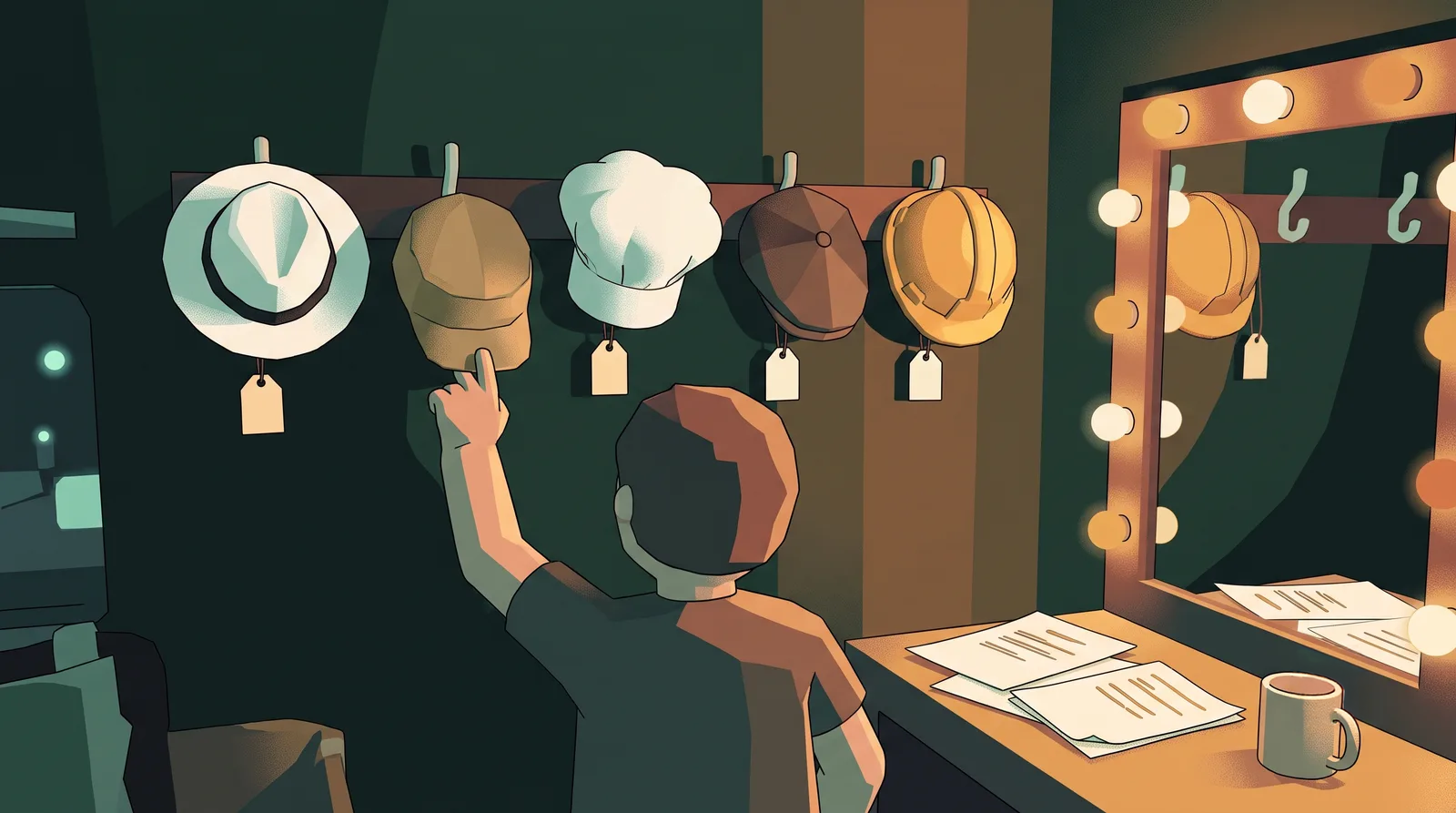
The same goes for our Copilot interactions. That default assistant persona? It’s your competent multi-instrumentalist. But when you need that client announcement to sing, you bring in the specialist. When you need that technical concept to land with new hires, you bring in the teacher. When you need to see blind spots in your strategy, you bring in the skeptic.
Sometimes multiple personas can help weigh in on the same topic! I may have a marketing director craft a comms plan, a client provide theoretical feedback, and finally an analyst review the plan for how much of a pain in the neck it would be to actually implement!
What This Means for Our Team Going Forward
As we continue integrating Copilot into more of our workflows, understanding persona dynamics isn’t just a nice-to-have: it’s becoming a core competency. Structured outputs with explicit validation criteria reduce hallucination while maintaining persona richness. In other words, the field is moving toward more sophisticated, more reliable ways to invoke and control personas.
Personas aren’t about tricking Copilot or gaming the system. They’re about clarifying intent, establishing context, and creating a shared understanding of what we’re trying to achieve. They’re about recognizing that communication (even with Copilot) is always relational, always contextual, always happening within a frame. And finding the right persona can achieve much deeper contextualization with way fewer words than some other context frameworks!
Your Next Experiment (Yes, This Means You)
Here’s what I’m challenging everyone to try this week. Take a task you regularly use Copilot for; maybe it’s writing emails, maybe it’s brainstorming, maybe it’s explaining concepts. Run it three ways:
- With no persona (your usual approach)
- With a relevant professional persona (“As a senior product manager…“)
- With something unexpected (“As someone who thinks in metaphors and analogies…“)
Pay attention not just to which one gives you the “best” answer, but which one makes you think differently about the problem. Because that’s the real power I’ve discovered with personas - they don’t just change Copilot’s output. They change the perspective of the conversation itself.
I’ve learned that sometimes the most powerful prompt isn’t about being the AI expert in the room. Sometimes it’s about being the five-year-old asking “why?” over and over again. Sometimes it’s about being the skeptic who won’t let easy answers slide. And sometimes (maybe most times) it’s about being playful enough to ask “but how would a toddler describe a six month enterprise campaign to increase Copilot usage”? Hint: the phrase We’ll make all the big people go WOAH real loud is going to live in my head rent free for a very long time.
The Working Question
Everything I write, in one inbox — blog posts, LinkedIn newsletter editions, and first word on new workshops. One email a month.